
Promotional stickers for the Fediverse
[ #opensource socialmedia mastodon x facebook instagram threads bluesky tiktok youtube The Fediverse is important to me. I realise it’s quite a nerdy thing to get worked up about, but I really see it as a solution to a problem that I think people don’t care about. A problem that people should care about a lot more.
The problem: Most people use social media owned by Big Tech.
Social media is media. And while “media” has different interpretations, one of them is “a source of news/information”. For young people especially (but definitely also older generations), it is increasingly the main source of news.
“Whoever controls the media, controls the mind”, as they say. It wasn’t a coincidence that Nazi Germany had a Ministry of Enlightenment and Propaganda: controlling what information people do and don’t see is simply huge for swaying people’s opinion on… stuff.
Stuff like queer social media accounts, for instance. Or No Kings protests in the US. Or who the better candidate for Brazil’s recent elections was.
Of course, that’s just the obvious influencing. I’ve been trying to promote this research on Mastodon:
The Fediverse
Anyway—all that to say that I think it’s important that people start moving away from big tech social media platforms. People who oppose fascism but keep using those platforms are actively aiding the things they oppose, if you ask me.
My preferred alternative is the Fediverse. I like it more than Bluesky, because Bluesky is corporate and owned by one company, and nothing’s stopping them from being bought by some billionaire, just like Twitter was. It’s “decentralized”, sure, but you need tremendous amounts of money and bandwidth to host an instance for it.
With the Fediverse, it’s quite affordable to host an instance yourself. A prominent Dutch newspaper, the NRC, just started their own instance, for example. But individuals could also host their own instance if they want.
Promotion
Of course, there’s a big problem with the Fediverse: it’s not corporate. There’s no budget for marketing and promotion, no money for attracting popular celebrities to it. There’s small companies like Mastodon and Pixelfed, that do have some budget, but they are not of a size where they could spend money there.
Any promotion for it, therefore, needs to come from the users. And those are mainly tech enthusiasts. Not widely-known for their aptitude with influencing large groups of people.
Stickers
I want to help, in a small way. Some promotional stickers are relatively affordable and if even a small group of users sticks some around the cities they live, a relatively large group of eyeballs can be reached.
But what should be on those stickers? I couldn’t really find a sticker that appealed to me. There’s two blog posts I really liked by Annie talking about promoting the Fediverse: Talk about the thing itself and Let’s talk about the fediverse.
This sounds like salient advice to me. I want to look at the existing offering for Fediverse-themed stickers and see what could be improved about them. If we distill Annie’s advice specifically for stickers, we can create a list of “rules” like these:
- Talk about the “thing itself”, not the underlying mechanisms
When you introduce someone to something new, try to talk about what it does for them, not how it’s built.- For stickers: Avoid technical jargon (things like decentralized, federated, protocol, instance, activitypub). Instead, highlight human connection and specific activities—finding book recommendations, sharing art, or keeping up with hobbies. You know, the things that made social media fun in the first place!
- Don’t use the name “Fediverse”
To quote Annie: “it sounds dumb af when you first hear it”.1- For stickers: Just say “social media” or “social network”, or use the name of a specific app or community instance.
- Tailor stickers to specific interests or places
Find common ground by focusing on what people actually care about and are looking for.- For stickers: Create targeted stickers for specific environments. A sticker near a library or bookstore could highlight the literary community; a sticker in a bouldering gym could mention finding local climbing buddies.
- Focus on positive rewards instead of shaming people2
Lecturing people about how awful Big Tech is doesn’t tend to work well (like I did at the start of this blog post, whoops). People already know these things, and making them feel bad about it will only make them dig their heels in the sand. (See: Sunken cost fallacy.)
Also, moving away from what you know takes energy. The reward of changing needs to exceed that effort. Marketing needs to be an invitation, not a soapbox.- For stickers: Emphasize positive benefits: Control your own feed, See what your friends are actually sharing, or Enjoy social media the way it used to be. Highlight fun and freedom instead of just opposing the “bad guys”.
- Tap into nostalgia or contrast with the status quo
Hint at the glory days of social media, making simple comparisons in the spirit of “like X, but without Y”.- For stickers: Go for something like: “Like social media, but you choose what you see.”
- Minimize the cost of changing and demonstrate equal value
For most people, social media isn’t something they want to work at. While it is important (they get their news from it, and whoever controls the media controls the mind), most people just see it as casual entertainment. They don’t want to expend energy learning a new system—that energy is saved for their job, health, or family.- For stickers: Make taking the next step effortless. Include a short, direct URL or QR code that leads straight to a simple landing page or sign-up screen, and emphasize that it’s free and takes seconds: “Join in 30 seconds at [link]” or “Free, ad-free, and easy to join.”
Some notes
-
Not using the name "Fediverse" seems problematic. Sure, Mastodon is a big part of the Fediverse, but why promote that instead of, say, Pixelfed? Besides, "Mastodon" is trademarked. One can't just create stickers for them without their consent.
- Besides, "Facebook", "Twitter", "Instagram" are also a bit silly, name-wise, right? Perhaps it's just a matter of getting people used to it.
- In marketing, there's usually an effort to try and frame things in terms of what you gain rather than what you avoid. Instead of "no corporate owners", you want to say "community-owned". Instead of "no ads" you want to say "only posts by other humans" or something. For stickers, though, there's then the issue that sometimes this leads to wordier posts. Something like "100% human posts" could work for "no ads", perhaps. But some concessions will probably have to be made here. ↩
- For the kind of guerilla marketing I have in mind, the stickers would ideally be made available within the public domain, so people can print them themselves. Organisations like Mastodon would do well to make their stickers downloadable like this as well, in addition to selling the stickers themselves. After all, it's promotional material for their product, it's still a good thing for them if people print them themselves even if they don't earn money from them directly.
Existing stickers
So what’s on offer right now? Let’s review a bit.
Official Mastodon stickers
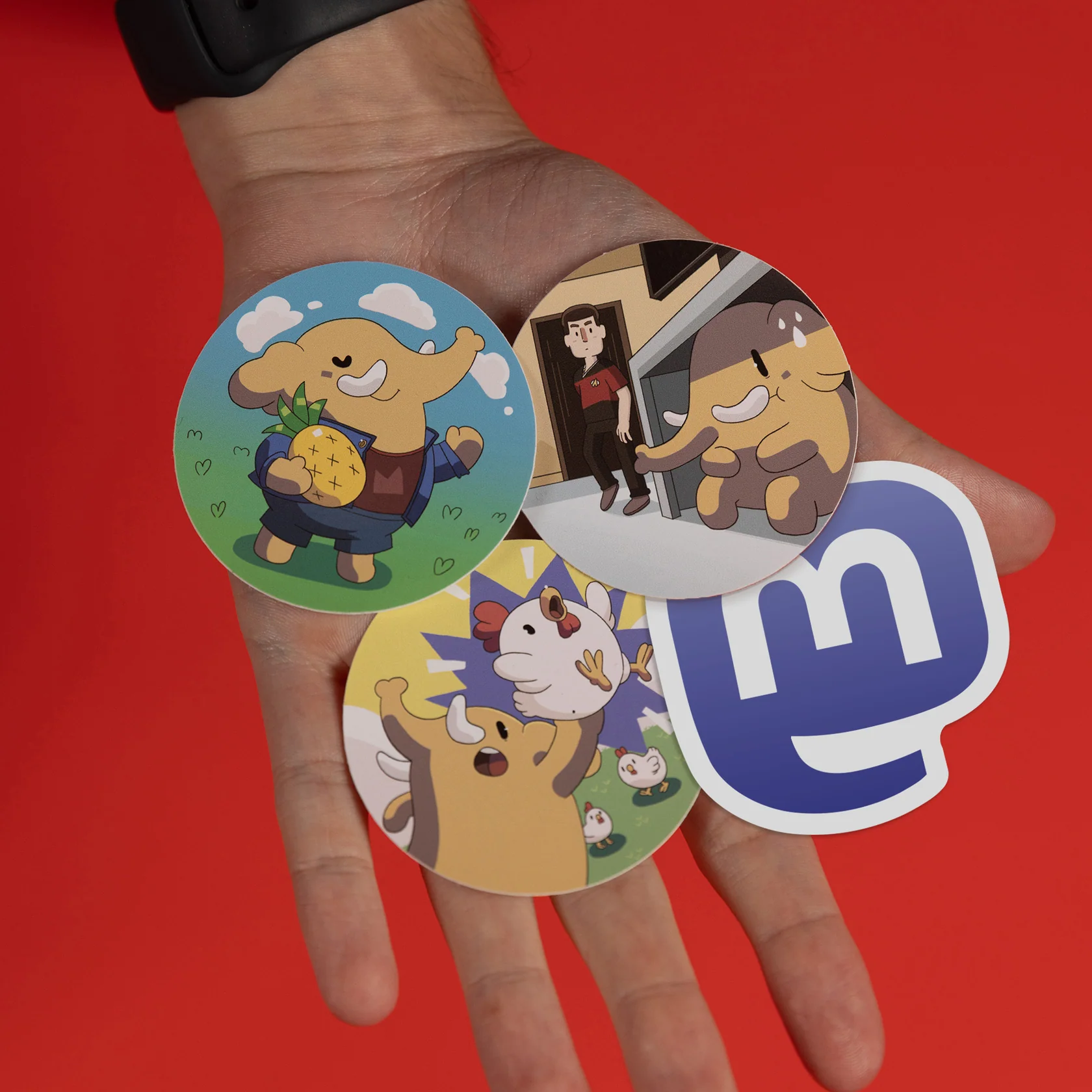 Official Mastodon sticker assortment.
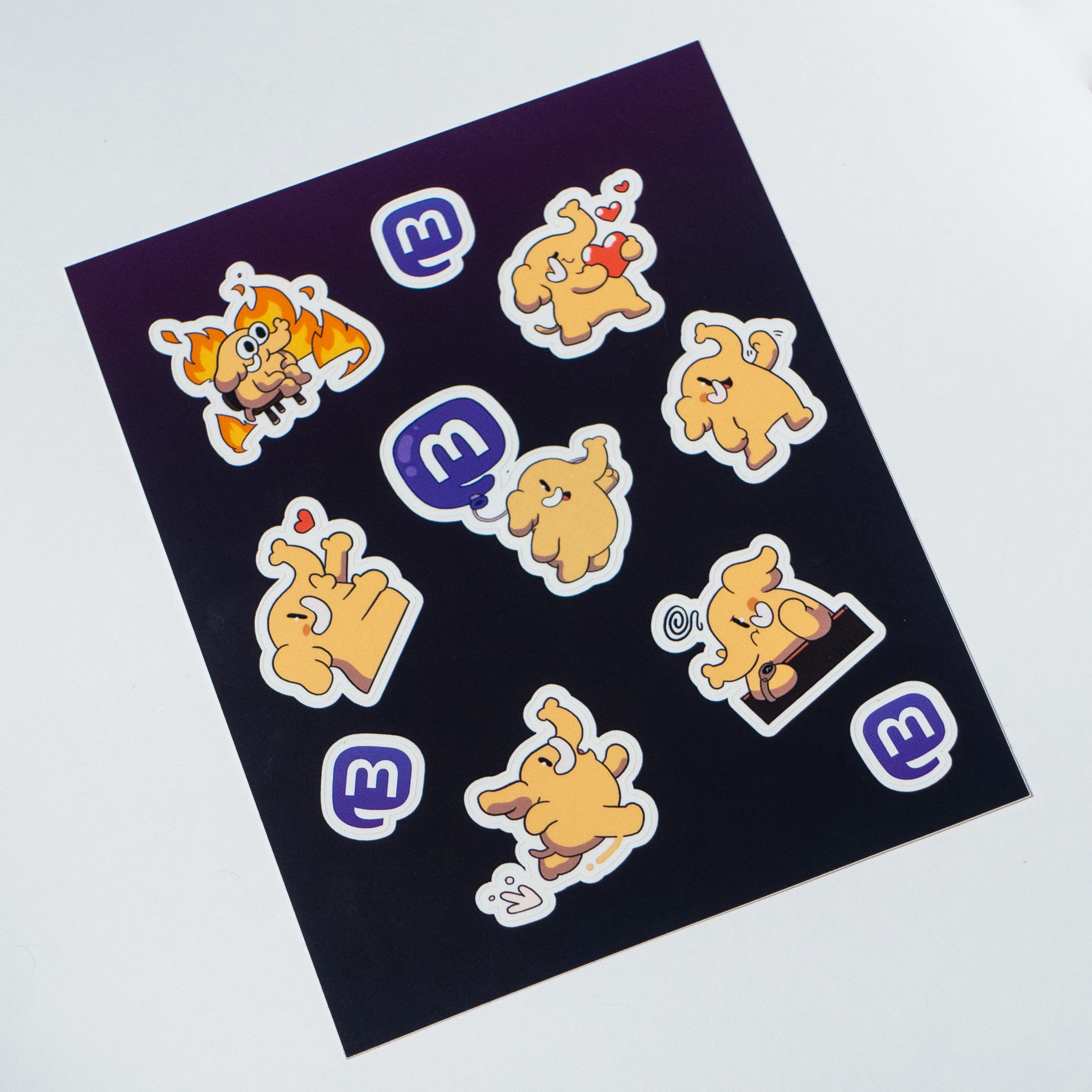 Official Mastodon sticker sheet.
These do not, in fact, have any text on them. You’d have to be familiar with the mascot and logo already to know what they’re promoting. There’s also this pin:
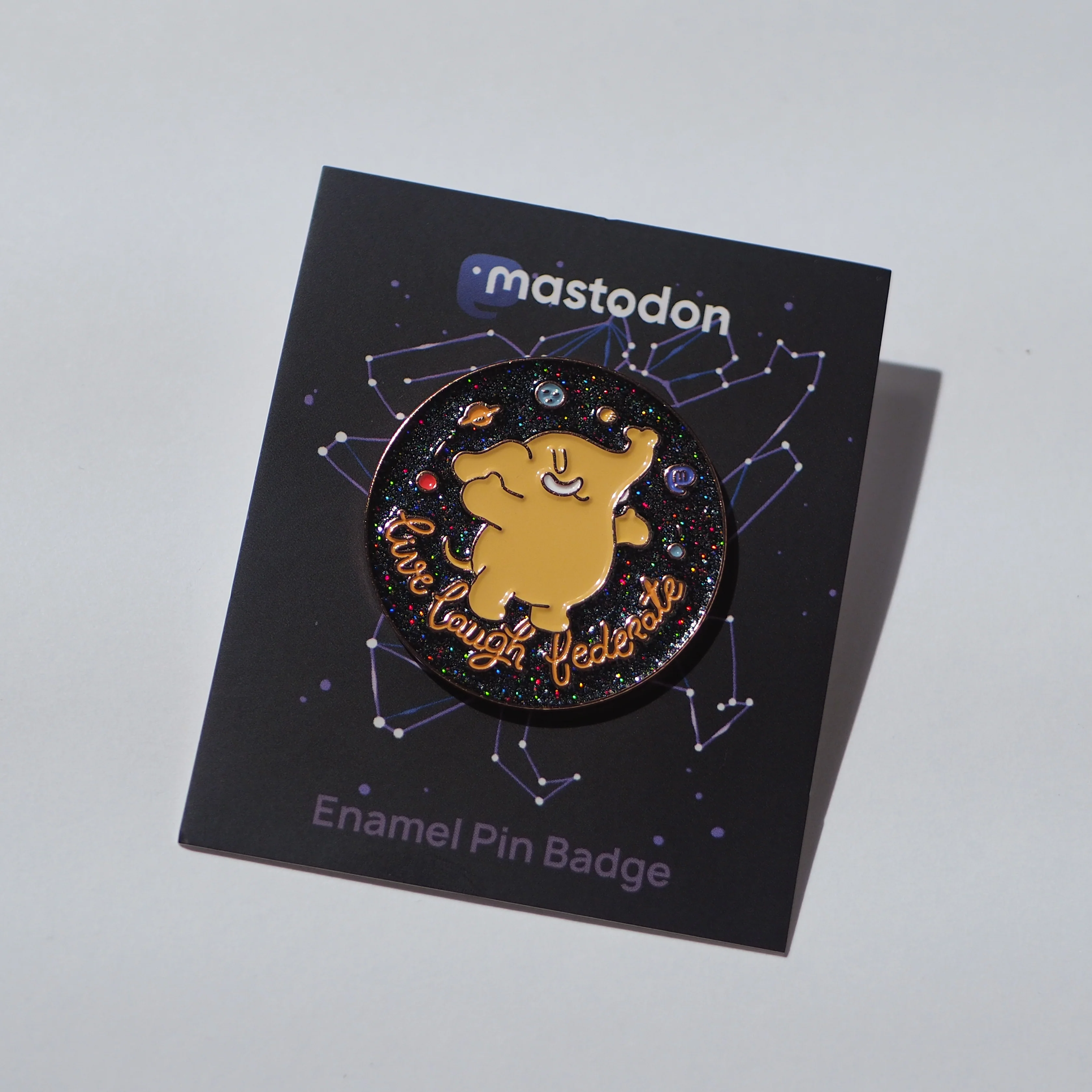 "Live Laugh Federate" enamel pin.
“Live laugh federate”, unfortunately, breaks the first rule of avoiding jargon. “Federating” doesn’t mean anything to Joe on the street. I suppose it does hint of loving and laughing on Mastodon, but people would have to be familiar with the mascot already to know where to find this loving and laughing.
Antifascist Fediverse
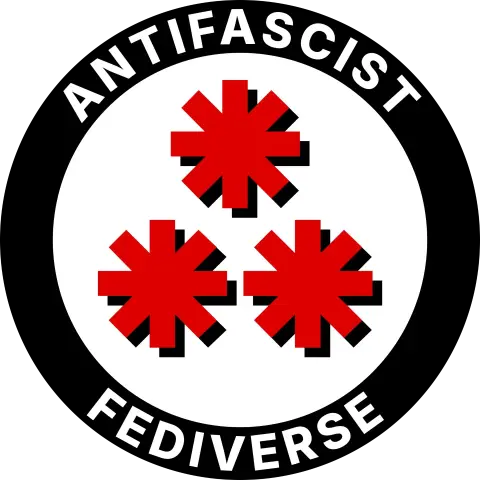 "Antifascist Fediverse" sticker.
This is the sticker that actually prompted me to write this post in the first place. I agree with the sentiment completely, but it’s a good example of a sticker that focuses on what you’ll avoid (fascism) rather than what you’ll gain (democracy).
Log Off Twitter!
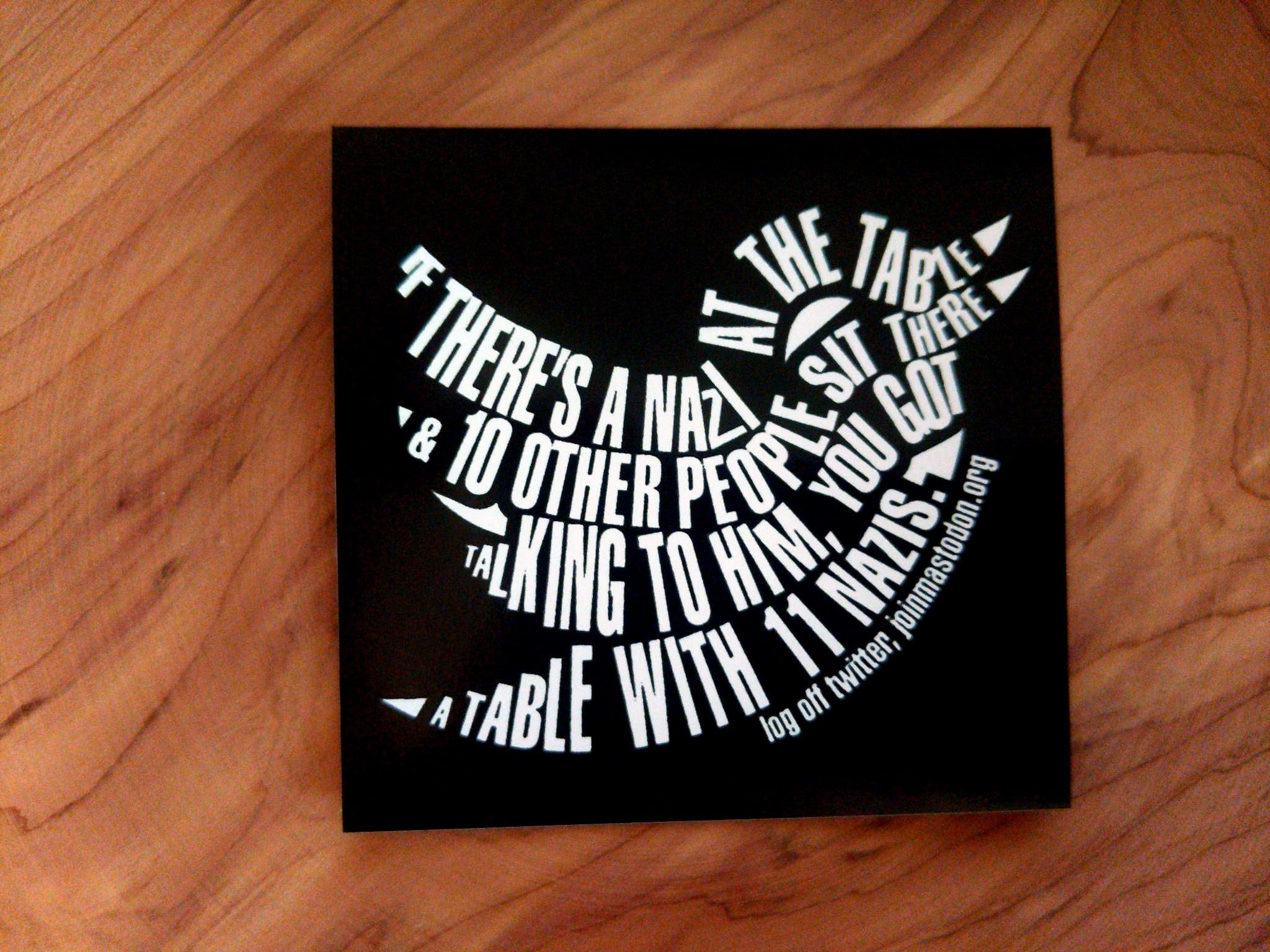 "Log Off Twitter" anti-Nazi quote sticker.
Another good example of focusing on what you’ll avoid (Nazis). On top of that, there’s a good bit of shaming there, suggesting that people sticking around on Twitter are basically Nazis. Not great, marketing-wise. (Not to mention the design. There’s too much text and it’s quite hard to read.)
A better approach would be to point people at what they’ll gain: a calm, predictable timeline where you actually see what your friends post, instead of what an ad-driven algorithm wants you to rage-click. Which is of course harder to put into a punchy one-liner, but them’s the breaks.
#FediverseForFreedom
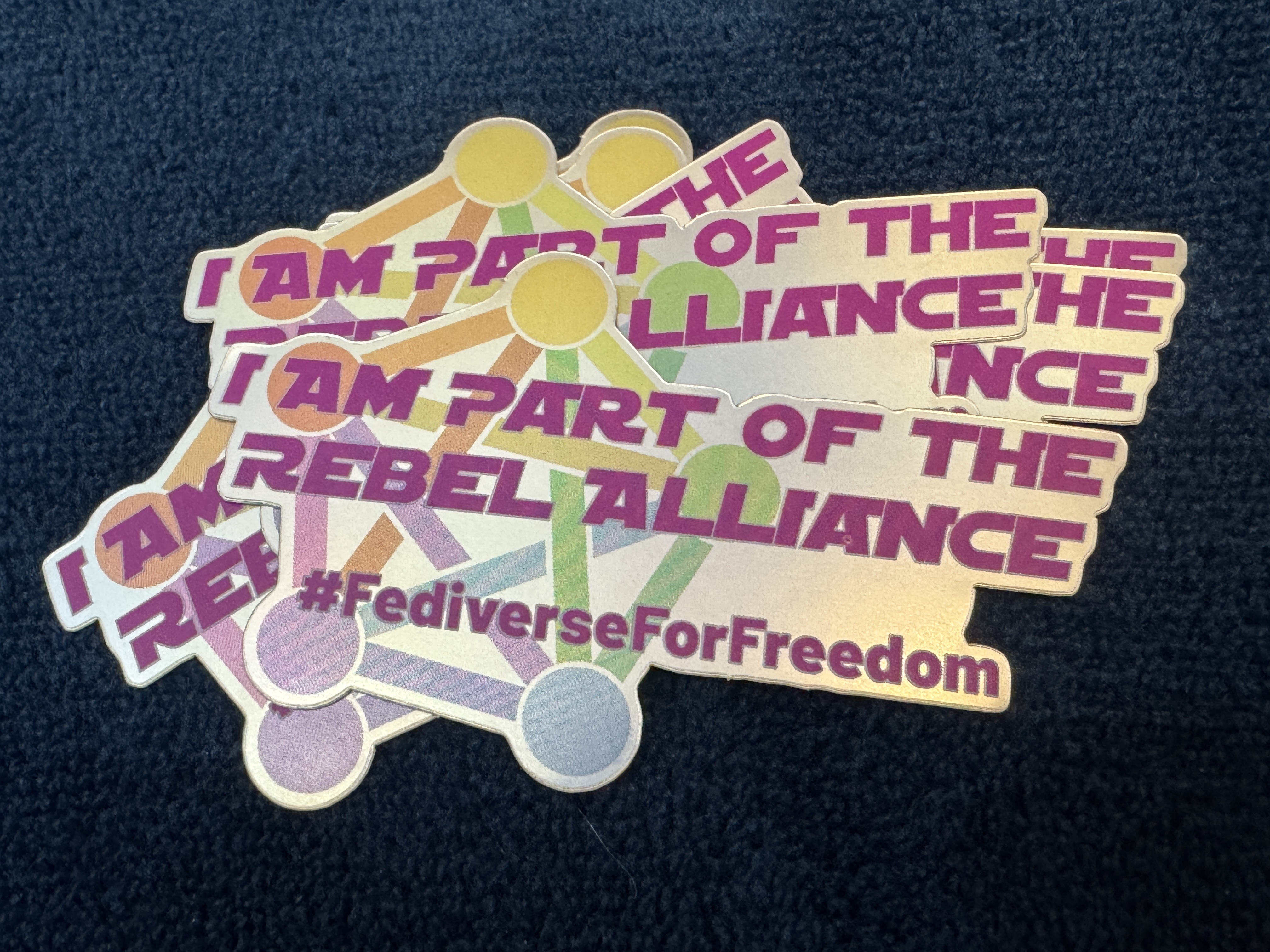 "#FediverseForFreedom" Rebel Alliance stickers.
A charming sticker by Andy Piper, the former head of communications for Mastodon. This one does conform to many of the rules above. It focuses on what people will gain: freedom! It tailors to a specific interest: nerddom!
What it definitely doesn’t do is follow rule 3. In fact, it only says Fediverse, and nothing else. Enigmatic marketing campaigns rarely work.
Fediverse Ad-Free Social Media
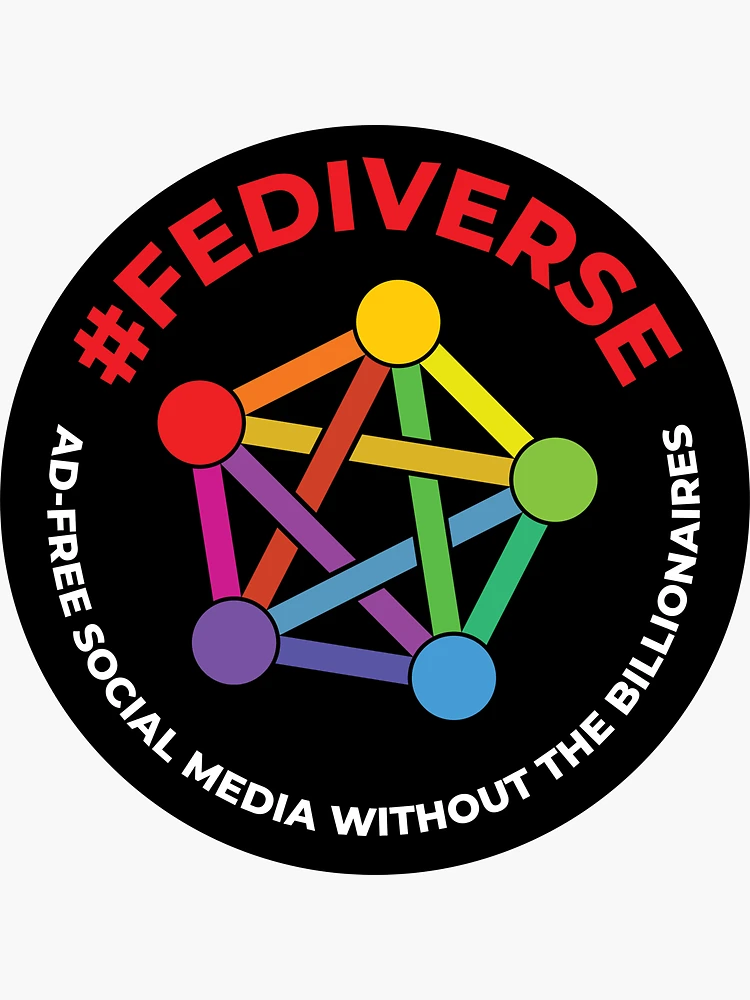 "Fediverse Ad-Free Social Media" sticker.
At first I thought this one was more positive, but on reflection… This still focuses on what people will avoid rather than gain. Goes to show how difficult it is to frame things like that! I guess marketing is a real business, after all.
So, as a thought experiment: how to reframe these things as gains?
- No ads → You choose what you see
- No billionaires → Community-owned
Needs some work. Too many words. But it’s a start!
No gods no masters no algorithm
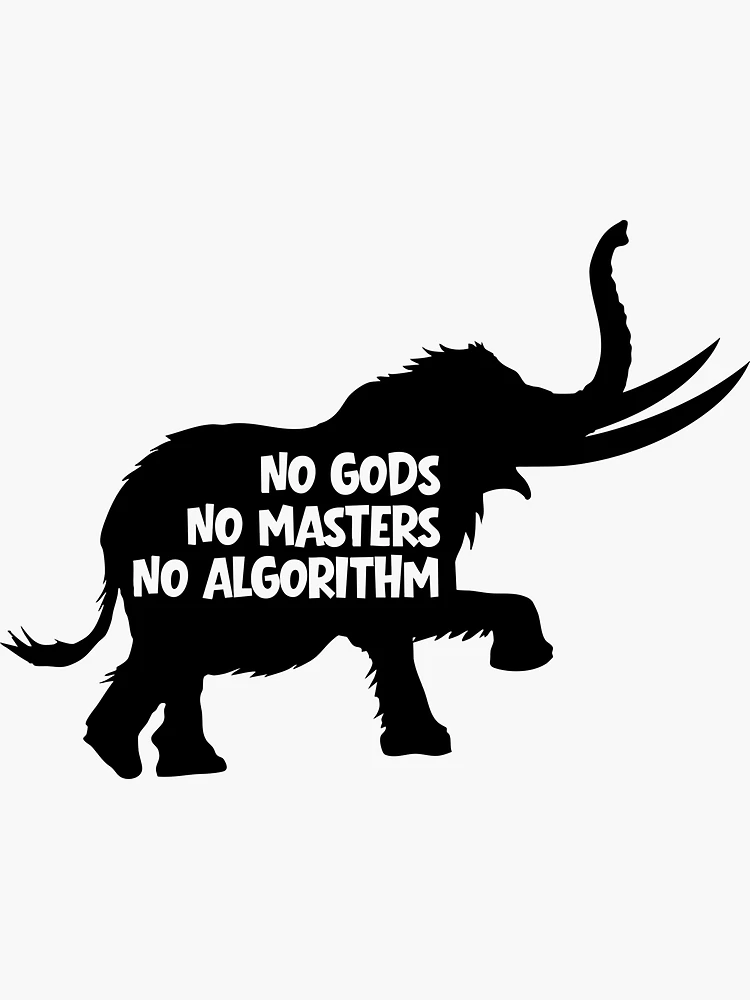 "No gods, no masters, no algorithm" mammoth sticker.
You know the gist by now: try not to frame the better platform in terms of what you’ll avoid. Also, do name the better alternative. This doesn’t even say “Mastodon”, it just uses the silhouette of a mammoth. This will attract zero new users.
Let’s do another thought experiment.
- No gods → Self-governed
- No masters → Community-owned
- No algorithm → You choose what you see
Leave the Metaverse and Join the Fediverse
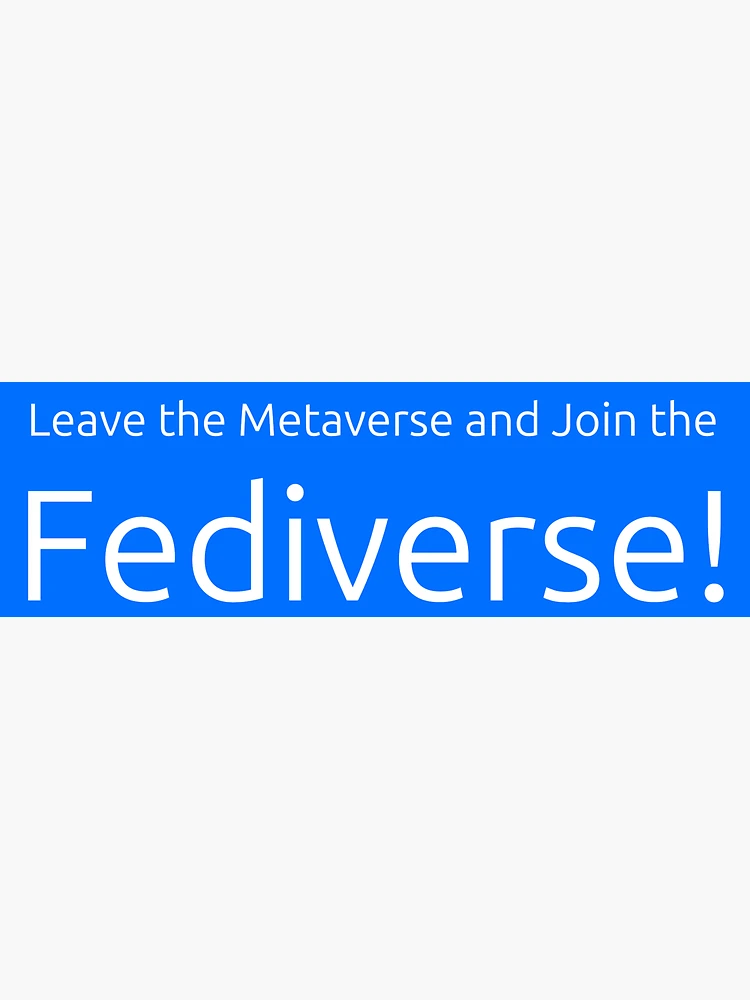 "Leave the Metaverse and Join the Fediverse" sticker.
The main issue with this one is the jargon. Joe on the street doesn’t know what the Metaverse is, nor what the Fediverse is. This sticker does nothing to explain that to him, either. He will not look it up himself.
Not a Fan of Big Tech
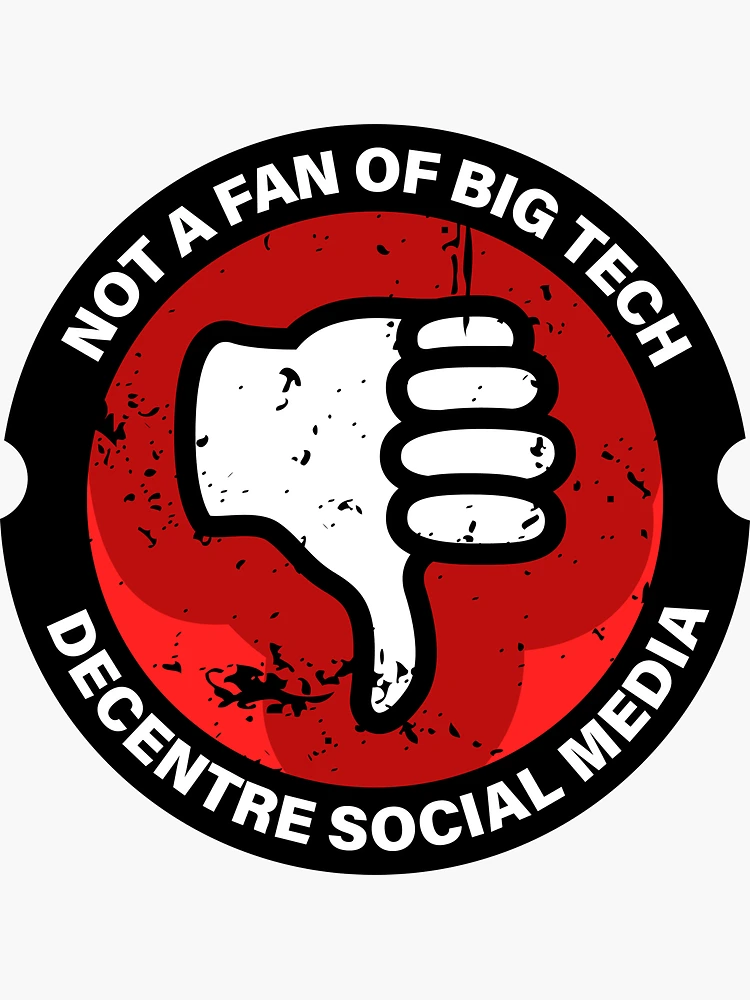 "Not a fan of Big Tech" sticker.
Definitely focusing on what people will avoid rather than gain. In fact, it doesn’t even name an alternative. Mostly, though, it reads as a “don’t do this” message rather than a “do this!” message.
Join the Fediverse
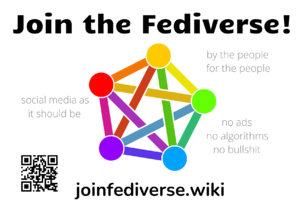 Join the Fediverse sticker.
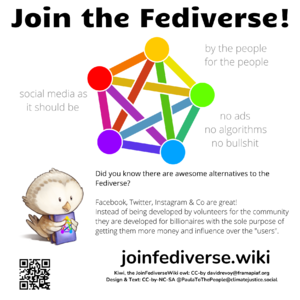 Join the Fediverse large sticker version.
Charming, and does a lot of things right. Two of the three main messages talk about what people will gain: “social media as it should be” and “by the people, for the people”. “No ads, no algorithms, no bullshit”, does list what people will avoid, of course, but it seems cushioned enough by the other messages.
What is up with that text contrast and size, though? Light grey on white? And why that passive-aggressiveness on the larger variant? That’s a good example of shaming people instead of making them excited for an alternative.
Protocol Not Platform
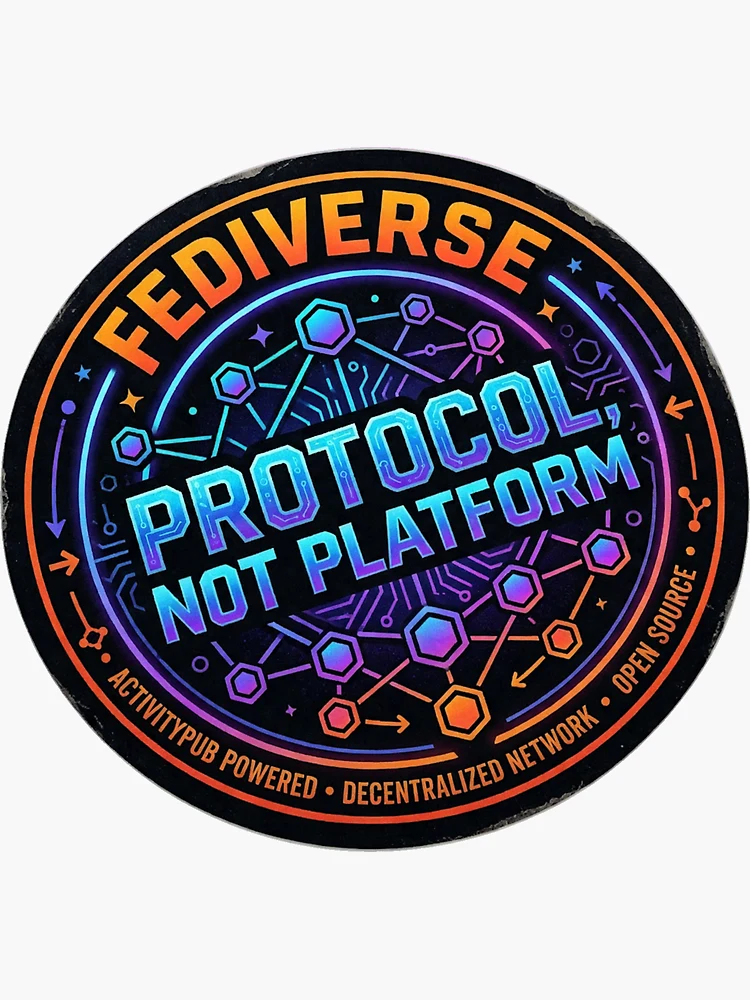 "Protocol, not platform" holographic sticker.
Quirky and quite visually attractive. Pretty hard to read, though, and definitely doesn’t follow rule 1. Very heavy on jargon and underlying mechanisms. This will only attract a very limited amount of technical users.
Fediverse stickers by Raphaël Bastide
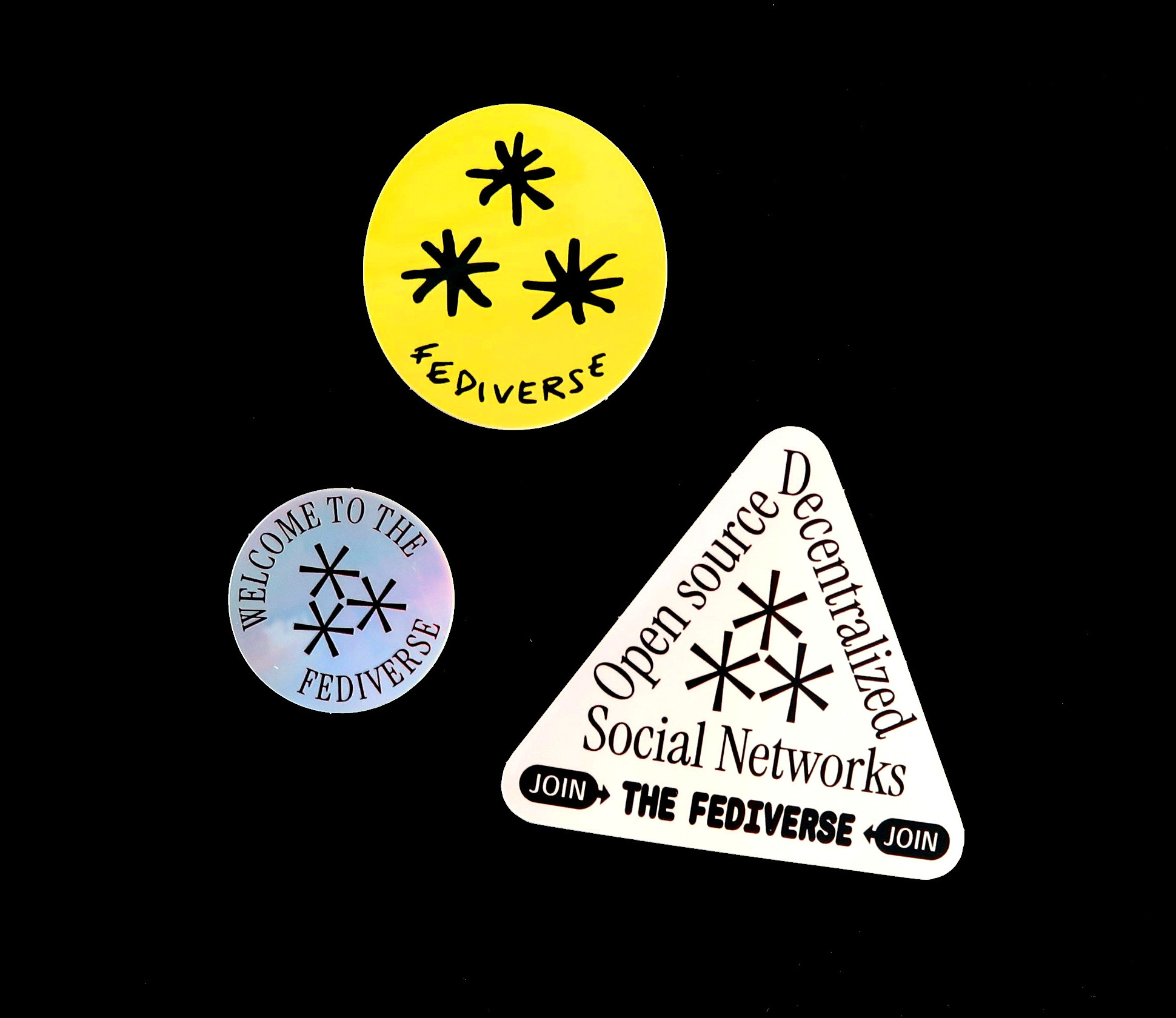 Fediverse stickers by Raphaël Bastide.
These feature the ⁂ symbol, proposed as an alternative symbol for the Fediverse instead of the pentagram icon. You can read more about it here.
These are pretty good. The problem is mostly with rule 2, you could say. I mean, as I said, maybe completely avoiding “Fediverse” is unnecessary, but it could definitely do with some cushioning explaining what it is and why people should join. At the least mention that it’s a social media.
The triangle sticker does that better, but doesn’t follow rule 1: it focuses on the underlying mechanism and not the thing itself!
A sticker that does work
I’m not really a graphic designer. I have dabbled in it a bit, and maybe I’ll create a proposal design in another blog post, later. For now, I just wanted to write this review of the existing material and note the opportunities for improvement. I’ll try to reach out to the team behind Mastodon and Pixelfed, for a start, to hopefully inspire them for future stickers.
Please also help out by sharing this post and, if you’re a graphic designer yourself, creating something yourself! #FediPromo
After all, if we want to get people off of big tech social media, we’ll need to grassroots it.
Some ideas for slogans to put on them:
- The European social media
- Social media for democracy
- Find your community (perhaps combined with a mascot performing different hobbies)
- You choose what you see
- You are in control of your timeline
- Community-owned
Fediverse promo material
Ideally, it would be great if some sort of collective database of Fediverse promotional material could be made somewhere. There’s something like it here, but it would be great to have, I don’t know, a hashtag like #FediPromo on Pixelfed or something, where people could go to download public domain imagery to download and print themselves. That’s the kind of guerilla marketing the Fediverse needs.
Until next time,
Sebastiaan Ammerlaan